The Polisario’s Contradictions: With Itself, With Europe, and With the Entire Universe
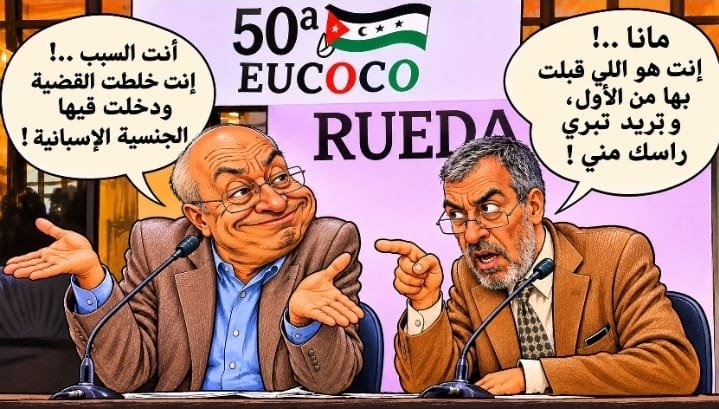
From Bouchraya Beyoun’s hopes for a change of government in Spain to Omar Mansour’s accusations against European democracies, the recent European tour by senior Polisario Front figures exposes the inconsistencies of a political discourse caught between denunciation, dependence, and repeated declarations of victory.
They say consistency is the virtue of fools. And judging by their recent appearances in Spain and across Europe, some leaders of the Polisario Front seem determined never to risk being accused of possessing such a virtue.
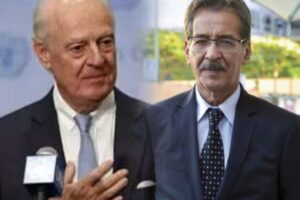
The delegation, with Bouchraya Beyoun and Omar Mansour among its leading figures, has delivered a remarkable political performance: statements that contradict one another, strategies pointing in opposite directions, and diplomatic victories celebrated with great enthusiasm, even when their actual consequences remain far less evident.
From microphone to microphone, from speech to statement, each intervention seems designed to contradict the previous one. One places his hopes in Europe, while the other accuses it of conspiring against the Sahrawis. One calls for negotiations while ruling out in advance one of the main proposals on the table. Both celebrate the Russian veto as a defeat for Morocco, without clearly explaining what concrete diplomatic alternative might emerge from it.
And so, amid solemn speeches and strategic contradictions, the conflict continues to await solutions.
1. Spain: Between Condemning Sánchez and Placing Hopes in the Right
One of the most striking contradictions appears in Bouchraya Beyoun’s statements regarding Spanish politics.
Beyoun sharply criticizes the Socialist government of Pedro Sánchez for supporting Morocco’s autonomy proposal for Western Sahara. Yet, at the same time, he places his hopes in a future Spanish government adopting a more favorable position toward the Polisario Front.
The problem is that such a change is far from guaranteed.
According to information attributed to Europa Press, the electoral platform of Spain’s conservative Popular Party (PP) does not explicitly commit to reversing Spain’s support for the Moroccan autonomy initiative.
Consequently, the expectation of a political shift in Madrid appears to rest more on an electoral gamble than on verifiable political commitments.
The paradox is obvious: the current government is condemned for a specific decision, while hopes are placed in another government that has never formally promised to reverse it.
And all this without explaining why a potential PP government, or a coalition involving Vox, would necessarily change Spain’s diplomatic position.
2. Europe: An Enemy in Speeches, Indispensable in Practice
While Beyoun hopes to find a political way forward through a change of government in Spain, Omar Mansour offers a considerably less optimistic, and at times openly hostile, interpretation of Europe’s role.
During his appearances in Madrid, Mansour accused European democracies of conspiring against the Sahrawis and participating in the exploitation of the territory’s natural resources.
What is surprising is not merely the severity of these accusations, but the context in which they were delivered.
Mansour was attending a meeting of EUCOCO, the European Conference for Coordination of Support and Solidarity with the Sahrawi People, a forum that brings together European parliamentarians, political figures, and organizations supportive of the Polisario’s cause.
This political contradiction deserves an explanation: how can Europe be portrayed as a collective adversary while simultaneously seeking the support of its parliamentarians, institutions, and civil society organizations?
Naturally, criticizing the policies of certain European governments is not incompatible with seeking support from other sectors of those same societies. However, a discourse that generalizes accusations against European democracies ultimately weakens that distinction.
The contradiction becomes even more apparent when Mansour describes European humanitarian assistance as mere “crumbs.”
It is entirely legitimate to debate whether that assistance is sufficient. What is harder to understand is the rhetorical contempt directed at aid that helps meet the essential needs of refugees living in the Tindouf camps.
Europe thus appears as responsible for much of the Sahrawis’ suffering while simultaneously remaining one of the principal arenas in which the Polisario seeks political and humanitarian support.
A complicated relationship, to say the least. Almost as complicated as explaining why the person helping you is your enemy, and why that enemy must nevertheless continue helping you.
3. The Russian Veto: Celebrating Victory Without Explaining Its Consequences
Another point of agreement between the two leaders concerns their interpretation of the Russian veto at the United Nations Security Council.
In their speeches, the episode is presented as a diplomatic failure for Morocco and a victory for the Polisario Front.
However, it is essential to distinguish between the legal significance of a veto and its political interpretation.
A veto prevents the adoption of the draft resolution submitted to a vote. It does not, by itself, mean that the international community has rejected every proposal contained in the text, nor that autonomy has been definitively ruled out as a possible political solution.
Still less does it demonstrate that a viable political alternative has been achieved.
The real question is what happens next.
Has the Polisario’s negotiating position been strengthened? Has a solution acceptable to the parties become any closer? Have greater guarantees been secured for the Sahrawi population?
Without concrete answers, the celebration risks becoming a purely rhetorical victory.
Furthermore, any claim concerning the withdrawal of MINURSO or the consequences of a United Nations resolution must be checked against the organization’s official decisions.
Diplomacy is not measured solely by the resolutions one manages to block, but also by the agreements one succeeds in building.
4. Negotiating With Morocco, but on What Terms?
Bouchraya Beyoun claims to be willing to negotiate with Morocco. At the same time, he maintains that autonomy is no longer a viable option.
This position raises a fundamental question.
Negotiating does not necessarily mean accepting the other side’s proposal. Nor does it require abandoning one’s political principles. But negotiations aimed at reaching a compromise require identifying which issues can be discussed and what alternatives are being offered.
If autonomy is ruled out from the outset, what concrete formula does the Polisario propose to break the deadlock?
On which issues would it be prepared to make concessions? What political, institutional, or international guarantees does it consider indispensable?
Defending self-determination may constitute a principled position, but it does not eliminate the need to explain how that principle can be transformed into a workable political solution.
That question remains insufficiently answered in the statements under examination.
5. Fifty Years of Obstacles and an Endless Series of Victories
Omar Mansour maintains that the Polisario continues to accumulate successes and that freedom is drawing ever closer.
At the same time, he denounces decades of international conspiracies and accuses major powers of constantly placing new obstacles in the movement’s path.
These two claims are not necessarily incompatible: a political movement can achieve partial progress while continuing to face significant difficulties.
The contradiction emerges when victories are presented as decisive without being accompanied by verifiable results that would allow their actual significance to be assessed.
After half a century of conflict, it is legitimate to ask which objectives have genuinely been achieved, which remain unresolved, and what strategy could overcome the current deadlock.
Because proclaiming victories is not the same as solving problems.
And a population that has spent decades waiting for a settlement deserves more than an endless succession of triumphalist statements.
6. Beyoun and Mansour: Two Discourses, One Strategic Inconsistency
Perhaps the most revealing contradiction is not necessarily found within the statements of either leader individually, but in the comparison between their positions.
Beyoun hopes that political change in Spain will improve the Polisario’s prospects.
Mansour, meanwhile, accuses European democracies of betraying the Sahrawis and acting against their interests.
One expects certain European governments to help deliver a solution. The other portrays Europe as a fundamental part of the problem.
It is possible to interpret these positions as a combination of diplomatic pressure and efforts to secure allies. However, such an explanation requires an identifiable strategy and a coherent message.
Otherwise, diplomacy begins to resemble an exercise in improvisation, in which each representative addresses his own audience without worrying too much about what his colleague said moments earlier.
One builds bridges while the other is busy blowing them up with words.
And both expect to reach the other side.
7. From Attacking the Sahrawi Movement for Peace to International Encounters
These contradictions can also be examined through the evolution of relations between certain Polisario leaders and the Sahrawi Movement for Peace (MSP).
During a television appearance approximately six years ago, according to accounts of that episode, Sneiba and Mansour directed harsh criticism at the MSP, seeking to discredit it politically.
The tone of those interventions contrasts with what reportedly happened later in Istanbul, when representatives of the Polisario and the MSP found themselves participating in activities associated with the Socialist International, following the latter movement’s admission to the organization.
The political symbolism is significant.
An organization previously portrayed as marginal and insignificant was subsequently present in a shared international forum.
Of course, attending the same forum does not necessarily mean recognizing an opponent’s political positions. But it does invite questions about the effectiveness of a strategy based on absolute dismissal and political vilification.
Perhaps the problem with declaring that a political rival does not exist is that, sooner or later, that rival may turn up sitting at the next table.
And then someone has to explain how a person who supposedly did not exist managed to find a chair.
8. Spanish Nationality and the Future of the Refugees
Another issue deserves particular attention: the position attributed to certain Polisario leaders regarding initiatives intended to facilitate access to Spanish nationality for Sahrawis.
According to the statements included in the material under examination, one official allegedly presented this initiative as a maneuver encouraged by the United States to disperse the refugees of Tindouf and weaken the Polisario.
This is a far-reaching accusation that would require concrete evidence.
The Spanish legislative initiative, supported in part by parliamentarian Tesh Sidi and several political groups, raises questions concerning historical ties, legal status, and the individual rights of Sahrawis.
It is legitimate to debate its political and demographic consequences. What seems unreasonable is automatically reducing a proposal intended to recognize individual rights to an international conspiracy.
The underlying question is particularly sensitive: should the strategic interests of a political organization determine refugees’ opportunities for mobility, legal documentation, and building a future?
Defending a collective cause should not prevent discussion of the individual rights and aspirations of those living with its consequences.
Refugees are not immovable pieces on a diplomatic chessboard.
They are people with plans, families, and aspirations that cannot remain indefinitely subordinate to the calculations of those who claim to represent them.
9. A Diplomacy That Needs More Than Microphones
The passing of prominent diplomatic figures such as Ahmed Boukhari and Ould Khadad also invites reflection on the evolution of the Polisario’s international representation.
Both belonged to a generation experienced in the complex mechanisms of international diplomacy and in engaging with governments and multilateral institutions.
The contrast with certain contemporary speeches raises an uncomfortable question: is the Polisario replacing strategic thinking with verbal confrontation?
The point is not to deny the existence of real obstacles or the historical difficulties surrounding the Western Sahara conflict.
Rather, it is to demand that political statements be connected to concrete objectives, negotiating alternatives, and measurable results.
Because diplomacy requires more than denouncing conspiracies, celebrating vetoes, or placing hopes in elections held in foreign countries.
It requires consistency, credibility, and the ability to turn political positions into solutions.
Conclusion: At Odds With Themselves, Their Neighbors, and the Entire Universe
At the end of the tour, the contradictions remain.
Beyoun criticizes the Spanish government while placing his hopes in another that has not guaranteed any change in policy. Mansour denounces Europe while participating in its solidarity forums and disparaging aid on which thousands of refugees depend.
Both celebrate diplomatic episodes as victories without demonstrating that they have brought the conflict any closer to a definitive settlement. They speak of negotiations while leaving the actual scope for compromise unclear. They proclaim historic advances while acknowledging the persistence of obstacles they have failed to overcome for decades.
Meanwhile, the Sahrawi population continues to wait for answers.
Perhaps the greatest contradiction is not the one between Beyoun and Mansour, nor the gap between their statements and diplomatic reality.
Perhaps it lies in the growing distance between the discourse of those who claim to represent the Sahrawis and the concrete needs of those who have waited far too long for a way out of the conflict.
Because some leaders seem to know perfectly well how to reach every microphone in Europe, yet remain unable to explain with the same precision the path toward a political solution.
And after fifty years, what is needed is not another victory speech. It is a map out of the labyrinth.



Post Comment